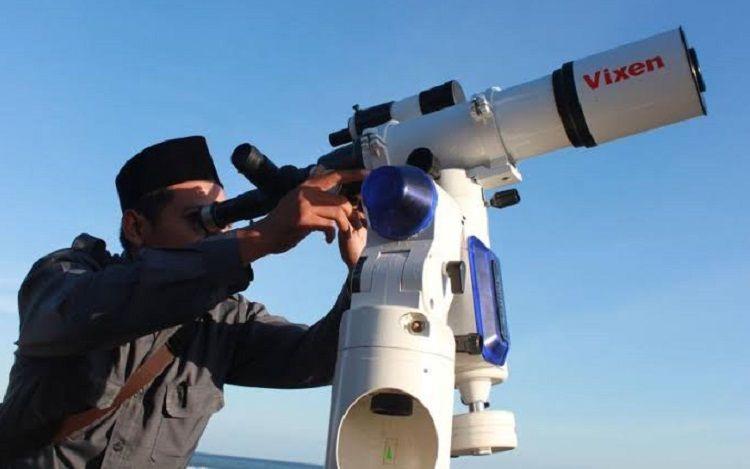
Talks about the beginning of Ramadan will never end, especially in our country, from the layman to the intellectuals warmly discuss it. This is a positive conversation, a conversation that makes our curiosity rise, hopefully that curiosity will be continued by a lot of reading and listening.
Indeed, the Qur'an does not explicitly explain how to determine the beginning of Ramadan, Shawwal and Hajj, it's just that there are several verses of the Qur'an that give hints for all of us.
An Indonesian scientist, T. Djamaluddin, Research Professor of Astrophysics Astronomy, LAPAN, who is a member of the Hisab Rukyat Agency, Ministry of Religious Affairs, has given a few astronomical explanations about the verses that give clues about the operational determination of the start of Ramadan, considering that so far what has been revealed in discussions -Discussions on determining the beginning of Ramadan are mostly just the hadiths of the Prophet .
In some of his writings he said that at first ﷲ سبحانه و تعالى gave an explanation to us in general when we fasted, through his words:
شَهْرُ رَمَضَانَ الَّذِي أُنْزِلَ فِيهِ الْقُرْآنُ هُدًى لِلنَّاسِ وَبَيِّنَاتٍ مِنَ الْهُدَى وَالْفُرْقَانِ فَمَنْ شَهِدَ مِنْكُمُ الشَّهْرَ فَلْيَصُمْهُ
"Therefore, whoever among you witnesses (the coming of) the month (Ramadan) then fast" (Qur'an 2:185)
Then ﷲ سبحانه و تعالى does not give a specific explanation how to determine the month has come. However, ﷲ سبحانه و تعالى seems to send His signal through the following verse regarding the behavior of the moon:
إِنَّ عِدَّةَ الشُّهُورِ عِنْدَ اللَّهِ اثْنَا عَشَرَ شَهْرًا فِي كِتَابِ اللَّهِ يَوْمَ خَلَقَ السَّمَاوَاتِ وَالْأَرْضَ مِنْهَا أَرْبَعَةٌ حُرُمٌ
"Indeed the number of months with Allah is twelve months, in Allah's decree when He created the heavens and the earth, of which four are forbidden months." (Qur'an 9:36).
The number of years is known by the repetition of the position of the moon in its orbit (manzilah-manzilah), i.e. 12 lunar phase cycles. The regularity of the repetition of the manzilahs is used for calculating the year, after 12 repetitions. Thus, we can calculate it. ﷲ سبحانه و تعالى says:
هُوَ الَّذِي جَعَلَ الشَّمْسَ ضِيَاءً وَالْقَمَرَ نُورًا وَقَدَّرَهُ مَنَازِلَ لِتَعْلَمُوا عَدَدَ السِّنِينَ وَالْحِسَابَ
"It is He Who made the sun shine and the moon shining and He appointed manzilah (the positions of the moon), so that you may know the number of years and the reckoning (of time." (Surah 10:5).
Manzilahs are marked by changes in the shape of the moon, from a crescent shape that grows bigger to become a full moon until it returns to a crescent shape resembling the thin arch of an old date palm, for which ﷲ سبحانه و تعالى explains:
وَالْقَمَرَ قَدَّرْنَاهُ مَنَازِلَ حَتَّى عَادَ كَالْعُرْجُونِ الْقَدِيمِ
"And We have appointed for the month of manzilah-manzilah, so that (after he reaches the last manzilah) he returns like an old heel." (Surah 36:39).
Then, which manzilah can be used as the beginning of the month? The initial Manzilah was the new moon, the new moon was a thin crescent shape. That's the timing (mawaqit) the beginning of the month, because the sign is clear after previously disappearing which is called the dead moon. ﷲ سبحانه و تعالى explains:
يَسْأَلُونَكَ عَنِ الْأَهِلَّةِ قُلْ هِيَ مَوَاقِيتُ لِلنَّاسِ وَالْحَجِّ
"They ask you about the new moon (crescent moon). Say: "The crescent is a time for mankind and (for the determination of the time of worship) Hajj." (Qur'an 2:189).
So what marks Ramadan, Shawwal and Hajj is the crescent moon (hilal), which is an observation phenomenon (rukyat), although at the same time this hilal is also part of the manzilah which can be known by counting (reckoning).
So eye observation (rukyat) with reckoning are not two contradictory things, both of which can be used for efforts in operational determination of the beginning of Ramadan, Shawwal and Hajj.
1. Rukyat Al-Hilal (Seeing the Moon)
When ﷲ سبحانه و تعالى prescribes a worship to His servant, ﷲ سبحانه و تعالى also explains the time, also gives instructions on how to know it. This is also the case with the Islamic fasting worship.
ﷲ سبحانه و تعالى and His Messenger gave instructions that fasting is worship whose execution time is based on the cycle of the moon. This Shari'a came into existence in the 2nd year of H, at a time when the Arabs and their surroundings were unable to read, write and count (astronomical calculations). Rasulullah said:
إِنَّا أُمَّةٌ ️أُمِّيَّةٌ ، لاَ نَكْتُبُ وَلاَ نَحْسِبُ ,الشَّهْرُ هَكَذَا وَهَكَذَا
"Indeed, we are the Ummi. We do not know the book (writing) and do not know the reckoning. The month is like this (he signed with the number 29) and like this (he signed with the number 30).” (Narrated by Bukhari and Muslim)
So it is very reasonable if in this case the prescribed way to know the time of fasting is by looking at the moon, because this method is considered the easiest way to be done by all humans, both past and present, lay or educated, rural or urban.
The Messenger of Allah in many of his sayings gives instructions about seeing the moon, among his sayings:
صُومُوا لِرُؤْيَتِهِ وَأَفْطِرُوا لِرُؤْيَتِهِ
"Fasting when you see it (hilal) and fasting (Eid) when you see it." (Narrated by Bukhari and Muslim)
صُومُوا لِرُؤْيَتِهِ وَأَفْطِرُوا لِرُؤْيَتِهِ فَإِنْ حَال بَيْنَكُمْ وَبَيْنَهُ سَحَابَةٌ فَأَكْمِلُوا الْعِدَّةَ وَلاَ تَسْتَقْبِلُوا الشَّهْرَ اسْتِقْبَالاً
"Fast by seeing the new moon and break your fast by seeing it too. But if there is a cloud that hinders, then complete the count and do not welcome the new moon." (Narrated by An-Nasa'i and Al-Hakim)
Although in fact the Ru'yat Al-Hilal method in its application there is little difference in the number of those who see it. Some argue that the testimony of one person who saw the moon can be taken. This is based on the hadith narrated by Ibn Umar.
تراءى الناس الهلال، فأخبرت النبي ️أني رأيته، فصام رسول الله صلى الله عليه وسلم، وأمر الناس بصيامه
"People were trying to see the moon, so I also came to the prophet and told him that I had seen the moon, so the Messenger of Allah fasted and ordered other Muslims to fast." (Narrated by Abu Dawud)
Some other scholars are of the opinion that the testimony of seeing the moon must come from two just Muslims, as a result of qiyas with testimony in other cases, also based on the narration of Husayn bin Harith that Al-Harist bin Al-Hathib an emir of Mecca said:
أمرَنَا رسولُ الله صلى الله عليه وسلم أن ننسكَ لرؤيته، فإن لم ️نَرهُ فشَهدَ شاهدان عدلانِ نَسَكْنا بشهادتيهما
"The Messenger of Allah ordered us to fast by looking at the moon, if we do not see it, then we have fasted with the testimony of two people." (Narrated by Abu Dawud)
Al-Hanafiyah circles in Hasyiah Ibn Abdin, vol. 2, p. 92 added that if the sky is clear, then it is not enough just to have one or two people's testimony, but it must be based on the testimony of many people, unless the sky is cloudy, then the testimony of one or two people can be accepted.
Because basically if the moon can be seen with the naked eye with a clear sky, then it is impossible for only one or two people to see it, so it is very natural that some scholars from the Hanafi madhhab are of the opinion that the testimony must be of many people.
If in the past rukyat (seeing) the moon only with the naked eye, now the process of seeing the moon has developed, supported by modern sophisticated equipment.
The presence of binoculars which can magnify an object up to thousands of times is very helpful in the process of observing the determination of the beginning of this Ramadan. So this method will get better results.
2. Hisab
As mentioned above that the method of determining the beginning of Ramadan with reckoning is not something disgraceful, that in the past there were some scholars who considered reckoning like this to be a forbidden science, but the science of reckoning referred to by the scholars was astrology commonly used by scholars. normal people to know the unseen. Of course, for the science of shamanism, all scholars agree that it is not permissible.
It was Mutharrif bin Abdillah, a tabiin leader who started giving an opinion on the use of reckoning after understanding the hadith of the Prophet which stated; "If the moon is not visible, then destiny". Say "faqdurulah" interpreted by: قدروه بحسب المنازل. (estimate with the science of reckoning), and the same is also confirmed by Abu Al-Abbas bin Suraij, one of the top Syafiyah scholars.
Some scholars who support this method consider that the eye observation carried out by the previous community was based on the fact that previously there had not been anyone who was qualified to do calculations with science.
The phrase revealed by the Prophet : "that we are a people who cannot read and count" rated as god (reason) the existence of eye observation (rukyat) as a marker of the beginning of Ramadan which the Prophet said.
With the condition of the ummah like that, it is very natural that the only choice is rukyat, because this is what they are capable of. It doesn't make sense if even with a statement like that the Prophet even ordered to use the science of reckoning.
But along with the development of science and technology, which was followed by the development of astronomy, so that it can calculate the motion of the moon with a very small error rate, even now the results are almost without error.
Shaykh Yusuf Al-Qaradhawy in his book "Kaifa Nata'amalu Ma'a As-Sunnah" explains how to understand the text of the hadith through the rules: التمييز بين الهدف الثابت والوسيلة المتغيرة (distinguishing between fixed goals and wasilah or ways that (can) change)
In this case he gave an example of the hadith of fasting Ramadan and rukyat, the words of the Prophet :
صوموا لرؤيته ـ أي الهلال ـ وأفطروا لرؤيته، فإن غم عليكم فاقدروا له
"Fast by looking at (the moon) and break your fast (Eid) by looking at the moon, if you are hindered by seeing the moon then make it your destiny"
Hadf The main (purpose) of this hadith is that all Muslims should fast for a full month in the month of Ramadan, and never leave a single day without an obstacle that allows them to fast.
As for seeing the moon (rukyat) it is only wasilah which is very likely to change from time to time, if at the time of the Prophet wasilah the easiest thing to do was only with naked eye observation, now observation can certainly be done using modern equipment, or it can also use science. reckoning with a very minimal error rate.
The imagination is that if the Islamic community had understood astronomy in the past, what wasilah would be recommended by the Prophet ?
If the news of naked eye observations from a just person at the time of the Prophet is acceptable, with a large error rate, it would be inappropriate to reject the calculation results with reckoning with a minimal error rate, or even almost no error.
Moreover, at this time this science has developed in almost all parts of the world. This knowledge is not knowledge that only a few people know. In Indonesia, this science continues to develop, until now there are two major methods that are often used in determining the beginning of Ramadan:
The Form of Al-Hilal (The Presence of the Moon)
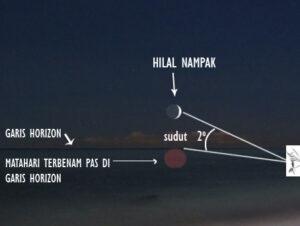
This is one of the reckoning methods used by some mass organizations in our country, Indonesia, especially Muhammadiyah. Simply put, the criteria for the Wujud Al-Hilal method must meet three things:
- There has been ijtima (conjunction),
- The ijtima (conjunction) occurs before sunset, and
- At sunset the upper disk of the moon is above the horizon (a new moon has formed).
If this third calculation of reckoning has been fulfilled, then we can be sure that on that night the new moon has entered, and the next day we have fasted, even without regard to the height of the moon, as long as its position is above the horizon.
Some consider that this method is a sign from the following words of ﷲ سبحانه و تعالى:
لَا الشَّمْسُ يَنْبَغِي لَهَا أَنْ تُدْرِكَ الْقَمَرَ وَلَا اللَّيْلُ سَابِقُ النَّهَارِ وَكُلٌّ فِي فَلَكٍ يَسْبَحُونَ
It is not possible for the sun to catch up with the moon and the night not be able to precede the day, and each one revolves in its orbit. (Surah 36:40).
However, according to T. Djamaluddin Research Professor of Astronomy Astrophysics, logically, it is impossible for the sun to chase the moon. But in this method, it is argued that there is a time when the sun precedes the moon, that is, the sun sets before the moon, so that the moon has existed when the night precedes the day (at maghrib). When it begins to form, it is considered the beginning of the month. But it's contradictory. It's impossible to catch up, but how come you can overtake. Such logic seems far-fetched.
The verse is astronomical not related to the form of the hilal (the existence of the moon), because at the end of the verse it is emphasized "each one goes in its own orbit". The verse describes the physical condition of the earth, moon, and sun systems. Even though the sun and moon look the same in the sky, their orbits are actually different. The moon orbits the earth, while the sun orbits the galactic center. The different orbits explain "the sun can't chase the moon" until whenever.
Night and day alternate regularly, it is impossible to suddenly be night because night precedes day. This is due to the regularity of the earth's rotation while orbiting the sun. Earth is also different in orbit with the sun and moon. Everything is out (yasbahun) in the space of the universe, nothing stands still.
Imkan Ar-Rukyah (Hilal Visibility)
The sign of the beginning of the month is the appearance of manzilah The first (phase) of the month is in the form of the new moon (crescent moon), this sign can be seen with the eye (rukyat) and can also be calculated (reckoning) based on the formulation of the regularity of the phases of the moon and previous rukyat data regarding the possibility of the new moon being rukyat. The data on the possibility of the new moon can be rukyat is known as criteria Imkan Ar-Rukyah or Hilal Visibility.
It seems that this method combines rukyat as a classical method recommended by the Prophet in many of his sayings, with a modern method through astronomy driven by a tabiin Mutharrif bin Abdillah, as a development of some of the words of the Prophet regarding wasilah or methods of knowing the moon.
The criticism of this method is that the parameters are not clear, that the size of 2 degrees, 3, 5, or 9 is a measure that does not have a definite standard, it can change. The rule is how can we rely on something that is not clear.
However, this method can at least be used in terms of eliminating the month even though the determination is still using rukyat. The point is that if in a matter of months the new moon cannot be seen due to the low position of the moon, then at least from here the judge can and may reject all testimonies that claim to have seen the moon.
In Indonesia, this fact often happens, that those who are in the Cakung area, in their testimony, the moon has been seen, although in terms of knowledge the moon is impossible to see. This testimony can be rejected by a judge.
Imam As-Subki once gave his statement in his book Fatawa As-Subki, volume 1, p. 219:
فقد ذكر السبكي في فتاواه أن الحساب إذا نفى إمكان الرؤية البصرية، فالواجب على القاضي أن يرد شهادة الشهود، قال: (لأن الحساب قطعي والشهادة والخبر ظنيان، والظني لا يعارض القطعي، فضلاً عن أن يقدم عليه)
"If the calculation states that it is impossible for the moon to be seen, then it is obligatory for a judge to reject all testimony about it, because the result of the calculation is qath'iy (certain) while the result of the testimony is zhonniy (relative), and something zhonni ( relative) cannot beat the qath'iy (definitely) especially if you prioritize the relative over the definite”
Agreed Things
However, there are a number of things that need to be agreed together in relation to determining the start of Ramadan, Shawwal and Hajj;
First: That the determination of the beginning of this month is very flexible, it is proven that both the rukyat and reckoning methods both accept differences. In the rukyat method the mistake is in the number of testimonies that must be received; one person, two, or must be many. While in reckoning, especially in Indonesia, it is possible to use two methods; The form of Al-Hilal or Imkan Ar-Rukyah with their respective advantages and disadvantages.
Second: Errors in this case, God willing, part of the mistakes that are forgiven, if indeed these two methods are carried out properly by experts. If used with all me and not by the experts, it can be ascertained that they are sinful in the sight of Allah SWT.
Third: That efforts to unite Muslims in fasting and Eid are two things that must be continuously fought for, and there should be no words of despair here, therefore if indeed Muslims around the world cannot be united with reality. ikhtilaf al-mathali', at least in this one country we are united.
The solution: Waiting for the results of itsbat trial?
So far, the solution offered in this country is the jargon "let's respect each other", but this jargon seems impossible to make the people of this country unite in the beginning of fasting and Eid.
For this reason, the following solutions can be offered, so that the differences in this country can be united, namely by following the government's decision. This is a rule that has been agreed upon by scholars that the judge's decision can eliminate existing differences.
And in the end Rasulullah also gave his advice to all of us:
صومكم يوم تصومون، وفطركم يوم تفطرون
"Fast on the day when all of you fast, and break your fast (Eid) on the day when all of you celebrate Eid." (HR. Tirmidhi)
Let's wait together for the decision of the itsbat trial, while preparing everything to welcome the fasting of Ramadan. May انه الى give His taufiq to all of us. May this year's Ramadan be better than previous years' Ramadan. Amen.
Wallahu A'lam Bisshawab
Source : https://www.rumahfiqih.com
Lecture snippet Ustadz Adi Hidayat about the Hilal and Hisab in 2019












 Sunnah.